
Lesli Lindgren • March 23, 2026, Keep Simple
If you've ever been told your business needs WordPress to rank on Google, you're not alone. That advice has been repeated so many times it started to sound like fact. But something shifted recently, and it came from an unexpected source: the person who built the world's most popular WordPress SEO plugin just said most websites don't need WordPress at all. Here's what that means for your Hawaii small business.
Key Takeaways
- The co-founder of Yoast SEO, the most popular WordPress plugin in the world, recently said most websites do not need WordPress.
- WordPress was designed for large, complex websites, not a five-page business site.
- Simpler platforms deliver the same SEO results, often with faster load times and less maintenance.
- For most Hawaii small businesses, platform complexity is overhead that costs money without adding value.
When the Yoast Guy Changes His Mind
If you've spent any time researching website platforms, you've come across Yoast SEO. It's the most widely used SEO plugin for WordPress, installed on millions of websites around the world. The person who built it is Joost de Valk.
This year, de Valk moved his own website off WordPress. Then he wrote publicly about why most websites don't need a content management system like WordPress at all, and Search Engine Journal covered the debate it sparked.
When the person who built the world's most popular WordPress SEO tool says the platform is overkill for most sites, that's worth pausing on.
His point was direct: WordPress solves a complexity problem. But most websites don't have that problem. Most websites are a few pages, maybe a blog, and they need to load fast, look good, and be easy to find on Google. For that, a simpler platform does the job just as well, and often better.
This isn't a fringe opinion anymore. It's a conversation happening at the highest levels of the SEO industry right now.
What WordPress Was Actually Built For
WordPress became the dominant website platform because it solved a real problem. Large websites with hundreds of pages, multiple authors, complex publishing workflows, and custom functionality needed a system to manage all of it. WordPress delivered.
It's a genuinely powerful tool for the right situation: news sites, large ecommerce operations, enterprise blogs, membership platforms. These are websites with real complexity that justifies a complex solution.
But most small businesses are not running a news site.
A local electrician needs a website that shows what they do, where they work, and how to call them. A tour operator needs to display their trips and take bookings. A restaurant needs a menu and hours. A salon needs photos, services, and a booking link. None of that requires the same infrastructure as a national media company.
WordPress, by default, carries all of that infrastructure with it. Whether you use it or not.
The Real Cost of Complexity for Small Businesses
Using an oversized platform for a small business website is not just unnecessary. It creates ongoing problems.
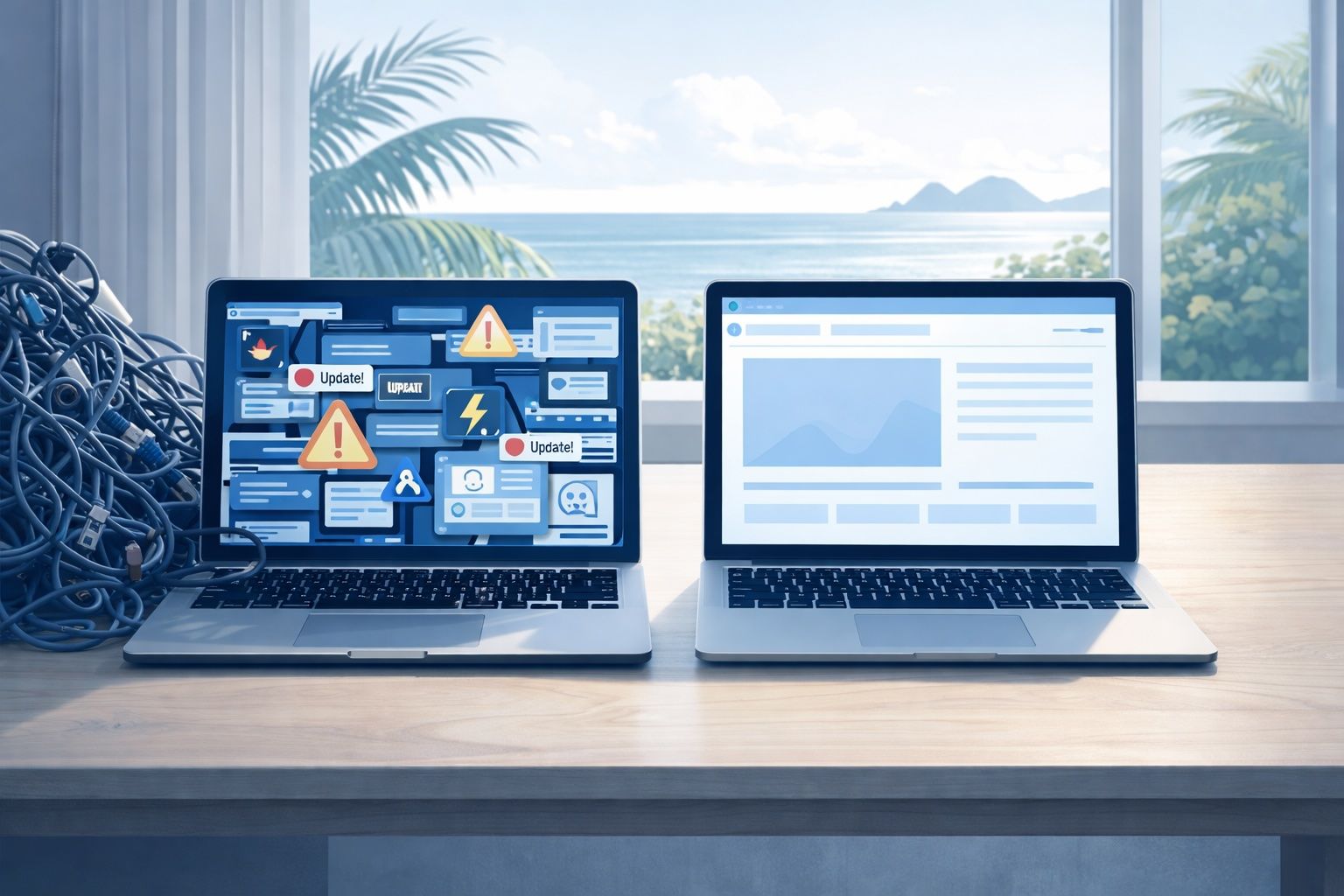
Every plugin you install to make WordPress do what you need is another thing that requires updating, another potential security hole, and another source of incompatibility when something breaks. And something always eventually breaks.
Then there's page speed. De Valk shared a specific example from his own migration: one page on his site went from over 1,400 lines of code down to 180 when he moved off WordPress. That kind of reduction directly affects how fast your site loads, and page speed is a ranking factor that Google takes seriously.
The SEO industry has documented this for years. WordPress sites, when not carefully optimized, carry a lot of excess code. Most small business owners are not carefully optimizing their WordPress sites. Most don't even know they need to.
For a small business owner, the cost is not just money spent on developers and plugins. It's the time spent worrying about a tool that should just run quietly in the background. It's the Saturday morning call from a customer who can't find your site. It's the update that breaks your booking form right before a busy weekend.
What Your Website Actually Needs
Here is the honest list of what a small business website needs to perform well:
- Fast loading pages. Google measures this and so do your visitors. A slow site loses people before they ever read a word.
- Clean, readable code. Search engines need to read your site easily. A simpler platform with clean output often does this better than a heavily loaded WordPress install.
- Accurate business information. Your name, address, phone number, services, and hours need to be correct and easy to find.
- A way to update content without calling a developer. If changing your hours or adding a new service requires hiring someone, that's a problem.
- A mobile experience that works. Most people searching for local businesses are on their phones.
None of that requires WordPress. These are achievable on a well-built modern platform without the overhead, the plugin juggling, or the monthly maintenance anxiety.
What This Means for Hawaii Small Businesses
Hawaii's small business landscape is full of exactly the kinds of businesses that get oversold on complexity. Contractors, tour operators, restaurants, salons, retail shops, service providers of every kind. Most of them need a website that works, looks good, and gets found.
What they don't need is to manage plugin updates or track down a developer when their site goes down before a busy weekend.
We've been building websites for Hawaii businesses since 2012. The businesses we work with don't want to think about their websites. They want to think about their customers. A website should be something that works for you quietly in the background, not something that demands your attention.
A properly managed website built on the right platform will outperform an overly complex WordPress site that nobody is maintaining. The Yoast co-founder just made that same case to an audience of SEO professionals. It's good to see the rest of the industry catching up.
If you're currently on WordPress and it's working well for you, that's great. Stick with it. But if it's causing headaches, running slow, or just feels like more than your business actually needs, it probably is.
For more on the specific costs and complications that come with WordPress for local businesses, read our earlier breakdown: The Hidden Costs of WordPress for Hawaii Small Businesses
Frequently Asked Questions
Is WordPress bad for SEO?
Not inherently. WordPress can rank well when set up and maintained properly. The issue is that it often comes with excess code and requires plugins to handle basic SEO tasks, which adds complexity and potential for things to break. Modern platforms, when built correctly, can match WordPress for SEO performance without that overhead.
What platform does Keep Simple use for Hawaii small business websites?
We build on Duda, a platform designed for professional web agencies and their clients. It's fast, secure, and easy to update without any technical knowledge on your end.ite visitors who are interested get more information. You can emphasize this text with bullets, italics or bold, and add links.
Can I switch from WordPress to another platform without losing my SEO rankings?
Yes, with the right planning. A migration that preserves your URL structure, sets up proper redirects, and maintains your content will protect your rankings. Done right, many businesses see an improvement because the new site loads faster and has cleaner code.
Do I really need a website if I'm already on Google Business Profile?
Your Google Business Profile handles local discovery well, but a website gives you space to tell the full story of your business, rank for more search terms, and convert visitors into actual customers. They work together, not as substitutes.
How do I know if WordPress is the right platform for my business?
If you're running a large ecommerce store, a content-heavy publication, or a site with complex custom functionality, WordPress can make sense. If you're running a local service business with a handful of pages, a simpler managed platform will likely serve you better with less ongoing cost and effort.
Ready to Keep It Simple?
If your website is giving you headaches, or you're just not sure it's doing its job, let's talk. We've helped Hawaii businesses across every island get online with websites that work, load fast, and don't require a tech background to maintain.
Schedule a free call and we'll take a look at what you have and what might work better for your business.
About the Author: Lesli Lindgren is the founder of Keep Simple Design, a Hawaii-based web design and SEO agency serving local businesses across the islands since 2012. She helps small business owners get online without the tech headaches.
